The fate of industrial civilization has come under serious question in recent decades as multiple crises build and seem to converge toward wide-ranging chaos, or even as some suggest, catastrophic collapse. The most prominent trend in that direction is the rapidly accelerating destabilization of the climate, one of the key components that has sustained the stability of the whole Earth System, until now. By the end of the eleven thousand years or so of the Holocene geological epoch, when optimum conditions facilitated human survival and development, humans have effectively taken over the planet.
 |  |  |
The power of human intellect, culminating in modern science combined with the economic myth of endless growth, enabled the development of ever more powerful technologies; then the advent of fossil fuels and their unique energy density accelerated the process to the limits of the Earth System’s capacity to carry the load of human extraction, production, consumption, and waste. At scale, growth has disrupted living earth systems at an increasing rate of acceleration. Most of that extreme expansion has occurred in the last few decades. When a species grows past the capacity of its habitat to sustain it, ecologists call it overshoot, which usually leads to collapse.
The systems of industrial modernism have overshot the capacity of the Earth System to sustain them. One major result of our overshoot is that evidence of increasingly deadly extreme weather events appears more and more often, due to carbon emissions that continue to grow, further disturbing climate.
We are now at a turning point, a point of no return to the halcyon days of post-World War II industrial and economic growth known as the “Great Acceleration.” We have effectively reached the limits of growth for industrial civilization. We cannot go back, nor can we move ahead on the economic growth trail. We must pivot in ways almost entirely new, especially new to our modernist imagination.
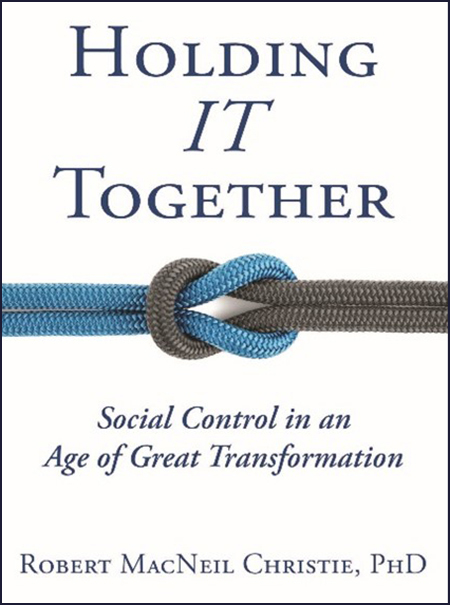
Holding IT Together: Social Control in an Age of Great Transformation explains how we got into this mess and what we must do to find a new path to a livable future. In his new book, Robert MacNeil Christie shows us where we went wrong on the path to economic prosperity for some, extreme wealth for a few, and exclusion and degradation for many. Certain cultural myths both enabled technological progress and economic growth while fundamentally misapprehending the very nature of human life on the planet.
Dr. Christie also explores the peculiar situation in which we have plenty of scientific knowledge to make the necessary changes, yet we do not. Powerful political-economic forces have prevented reasonable responses to climate and ecological destabilization by resisting any effort to take science-based rational action. He explains why the dominant institutions of industrial modernism contribute to growing ecological and political chaos and the resulting societal instabilities we suffer.
In each of several chapters, Holding IT Together demonstrates how particular institutions, culture, and the hierarchies that control them prevent the collective actions to transform the way we live, which are necessary for human survival by constraining the increasingly unlivable conditions of the Anthropocene.
Today’s core economic practices and forms of organization must be replaced by ecological communities and societies that enable humans to live in harmony with our home, the Earth System. Holding IT Together explains how we can get out of this mess and shape a livable future in ‘a place of our own’ on this almost still beautiful planet Earth.
Holding IT Together: Social Control in an Age of Great Transformation offers a thought-provoking probe into the mechanisms of social control and their impact on humanity’s ability to survive dilemmas of its own making… Dr. Robert MacNeil Christie embeds history surrounding social deconstruction and construction with the kinds of modern references that readers will relish… Christie offers an unprecedented opportunity for readers to apply the basics of economic understanding to the major issues facing humanity’s survival today…
Especially intriguing is the manner in which Christie points out… better choices for environment and world, but which revise the opportunities and approaches of individuals who operate under such systems and assumptions… Hope is embedded throughout his approach…
Libraries seeking treatises on the major dilemmas of modern society and living, who look for well-researched blends of and contrasts between different viewpoints…will find Holding IT Together especially relevant…with the one/two punch of historical precedent and the special challenges involved in building a new ‘ecological civilization.’
-Diane Donovan, Senior Reviewer, Midwest Book Review
 Robert MacNeil Christie, Author