Photo credit: TED Talks
Oddly, it seems, I wrote an email to a multi-billionaire the other day. (I don’t actually know any billionaires.) I happened upon a TED Talk on YouTube by Nick Hanauer, who described himself as a billionaire entrepreneur in the 0.01% of the wealthiest Americans. He proclaimed himself a capitalist, but talked of a new economy that he called “economic humanism,” which must be built “from the middle out,” not from the top down.
It was a surprise to hear this talk challenging the dominant economic system that made him mega-rich, from one of the richest men in America. His talk was also one of the most articulate summaries of why the dominant neoliberal economic ‘order’ we suffer from is fatally flawed and destructive to society. It was an unusual perspective from inside the beast.
Although Hanauer called himself a capitalist, he recognizes that markets must be managed in the interests of humanity, not overridden by the power of investment capital. That runs directly against the grain of our dominant economic ideology that helps capital dominate society, regardless of the human cost. Of course, if you have read my blog, newsletter, or books, you know that this is essentially what I have been harping about for a couple of decades. But he put it all together so well, and with exceptional clarity.
So, on listening to him speak, I felt compelled to write an email to Mr. Hanauer, praising his TED Talk and suggesting that a couple of things he had not addressed are extremely important for his argument for a new economy based on human wellbeing. Here is my “letter to a multi-billionaire”:
Dear Mr. Hanauer,
While I found your TED Talk stunningly clear and comprehensive, I do have a suggestion regarding what is missing from most assessments of our economic, political, societal, and ecological conditions, as well as from the rational arguments for change. The trends that result from the ascendancy of neoliberal economics and the corporate/state structures it has facilitated have become no less than ominous for everyone, paupers and billionaires alike.
Having focused on the trends in climate change in relation to the political economy for the past twenty years, I have come to conclude that rational arguments—yours being probably the most coherent, clear, and understandable for the non-specialist as well as we academics and other experts—are not enough.
Because of your clearly correct understanding of necessary societal change, and the fact that you are putting your money where your mouth is, I would ask that in the work you do on these things, you consider some key factors that I have come to consider imperative targets for action.
Unfortunately, these factors also constitute the “2000-pound gorilla in the room” that nobody seems to see.
First, Earth System variables have already disrupted natural systems so much that the predictions I have seen for a global drop in population within the next decade or so to about 2 billion seem unavoidable. Even if such estimates are off by a lot, population loss of even a billion or two alone means a lot of societal chaos, making economic reform all the more difficult. We are in store for much more climate migration and likely resource wars. The US will not go on in isolation from such major world events.
Second, we already live in the early stages of what I call “The New Great Transformation” of modern civilization (a reference to The Great Transformation, Karl Polanyi’s prescient 1944 economic history of the industrial revolution and reflections on its future), due to those same forces triggered by neoliberal economic policy and practices, and the extreme concentration of wealth with attendant increases in poverty. So, we have the convergence of what are likely to be growing points of major chaos, both ecological and societal.
The New Great Transformation is already happening. The question is whether we will take the cooperative initiative to redirect it toward the most positive trajectory or let it continue to spin out of control. Current political trends and the delays they cause suggest the latter as most likely, hence the necessity for large-scale cooperative societal action.
In complexity theory, initiating change requires finding vulnerable ‘leverage points’ to intervene in the system, then deploying change-actions. (Meadows, Thinking in Systems, 2008). Meadows outlines twelve such leverage points in complex systems. In the emerging global crisis that confronts us, a major effort to develop practical actions at key leverage points in the neoliberal political economy seems imperative at this critical juncture. I don’t see anyone doing exactly that. If they are, they have not entered the public discourse yet.
That is why I am writing this (over-long) plea. Someone with the resources and the right perspective, such as yourself, is desperately needed to either take up this challenge or support those who can and will, if adequately resourced.
Current technological trends, primarily related to AI, driven by the most powerful and erratic of your billionaire peers, run directly counter to the economic changes you would like to see, and of course the concomitant political trends make what I suggest is of the utmost urgency. I hope this missive does not land in your dustbin of email overload. If you are interested in discussing this, I am open to do so at any time. My recent book (see below) further explains my perspective.
PS: I am not looking for a job; I just want to stimulate the kind of societal action I know is imperative if we are ever to reach the kind of New Economy that you so clearly understand to be the right path.
Sincerely,
Robert MacNeil Christie, PhD
Professor Emeritus of Sociology
Founding Director, Urban Community Research Center
California State University, Dominguez Hills
505-795-6632
Holding IT Together: Social Control in an Age of Great Transformation
Hopeful Realism: A Climate Manifesto (an Amazon eBook)
robert.macneil.christie@gmail.com
https://robertchristie.substack.com
I wrote that about a week ago. I didn’t expect a quick response. I imagine a billionaire’s inbox is frequently filled with all sorts of requests from all sorts of people, and that various assistants handle the bulk of it, perhaps thereby making my effort to get Nick Hanauer’s attention a bit foolish. On the other hand, a man of such resources and apparent resourcefulness might have assistants who recognize some emails as not fan-mail or hate-mail, and worth his attention. We shall see. In any case…
The consequences of neoliberal economic policy and corporate practices during the last few decades demonstrate a complex system in failure. Why? Because systems cannot survive without their inner workings being in harmonic coordination for the benefit of the whole system, able to maintain all of its components in good health. When an economy is not in balance, with money not flowing freely throughout as needed, the system inevitably begins to falter, no matter how rich the rich are.
I discovered, on looking at Hanauer’s website, that he has collaborated with another former Silicon Valley insider, Eric Beinhocher, now a professor at Oxford, on a new book, Economic Humanism, which details the model for an economy based on human flourishing. The website offers a free ‘booklet’ (164 pages) based on the longer book. The underlying principle is that a flourishing humanity cannot exist under the oppressive prescriptions of an economy designed to support the accumulation of capital at the expense of human wellbeing. The flourishing of humanity must be the underlying basis of any legitimate human economy.
That is what Beinhocker and Hanauer have concluded about the most recent operations and failures of the neoliberal economic domination of American society. Neoliberal economics is closer to a religion than a science, regardless of its complex mathematical smoke and mirrors. Contemporary scientific findings on human behavior and systems contradict its claims of the pure “economic man” for whom “Greed is good”—end of story. Because neoliberal economic ideology dominates policy and practice, the system forces the society’s income and wealth up into the highest levels of the hierarchy, resulting in widespread stress, anxiety, fear, and poverty for an ever-growing majority of the people. The neoliberal economy serves the interests of the super-rich at the expense of everyone else.
Here is the graphic showing major loss of earning power for 90% of American workers over the last half century, presented in Darter C. Price’s report for the RAND Corporation, and cited in Hanauer and Beinhocher’s ‘pamphlet,’ Markets Built for Humans. Download and read it; it’s free.) The plummet in most workers’ share of national income is stunning.
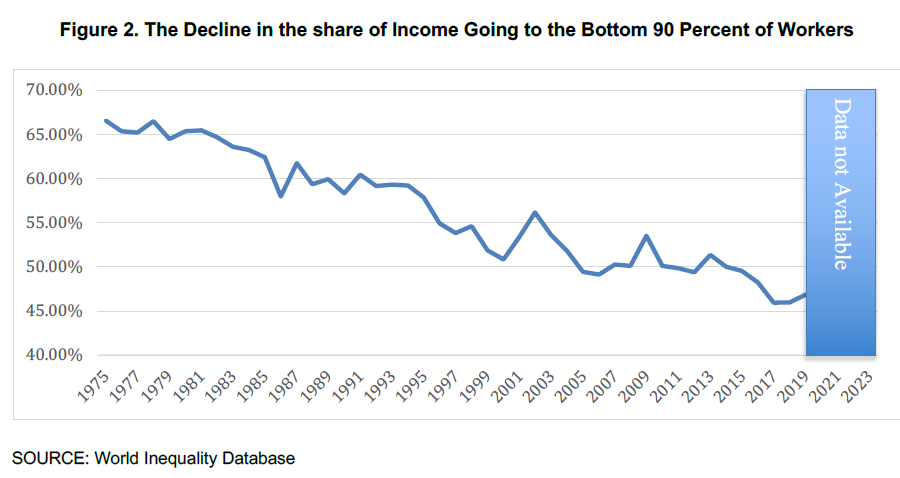
“Cumulatively, the gap between what workers from 1975 to 2023 earned and what they would have earned with the counterfactual income distribution amounts to $79 trillion (in 2023 dollars).”[emphasis added.] (Carter C. Price, “Measuring the Income Gap from 1975 to 2023,” RAND Corp).
That is a stunning loss of income and the resources for those among the bottom 90% of American workers. It is also a windfall for the top 10% of ‘earners,’ most of it going to the top 1% of the top 1%. Extreme income disparities are just one area of system dysfunction. But, as damaging to the human system (and most people) as they are, the larger venue of destruction is the entire Earth System itself. However equitable an alternative wellbeing-economic model may be, it must be considered and also deployed as part of an overall effort to salvage the place of humanity in the Earth System, which is our only home. Human wellbeing cannot be achieved without Earth System wellbeing.
As much as I admire the work that Hanauer and Beinhocher have done, I am disappointed, but not very surprised, by the lack of connection made to the larger human and global ecological context in that work. A wellbeing-based economic system that manages capital in the human interest, is imperative. But it is also impossible in a world where restoring and maintaining the natural sources of human sustenance and flourishing are not an elementary part of the economic equation.
As I reflect on the entirety of efforts to build an economy that serves the needs of humans to develop and flourish, much of which Hanauer and Beinhocher cite in their work, I am continually struck by the detachment that so much of that effort sustains in reference to the ultimate arbiter of our very existence: NATURE. Where to go from here?
Well, it gets back to the reason I wrote that letter to Nick Hanauer. The few people in this world who have both the intellectual and moral grasp of the trajectory of industrial civilization in the hands of neoliberal capitalism, and have the resources to take significant action, are rare. They include Nick Hanauer and Eric Beinhocher, and a few others. They see the flaws in the human system despite being enriched by it, and are willing to expend vast resources to help create an economy for us all.
In the present political context, little can be expected of the federal government, dominated by its autocratic anti-human regime—actually, its ‘contribution’ is negative. A bit can come from local and regional (state) jurisdictions that react to direct threats to their own viability, but their power is limited by resource constraints. Only by strategic application of intellect, money, and the mobilization of citizens for change-action will the goal of creating an equitable economy be possible.
That will require building a humanist economy to evolve in direct coordination with transforming our relationships with our only source of survival, the Earth System itself. To do so will require building a process of finding and acting on key ‘leverage points’ to intervene in a very complex and powerful political economy bent on self-perpetuation and growth, without regard to its human constituents.

